
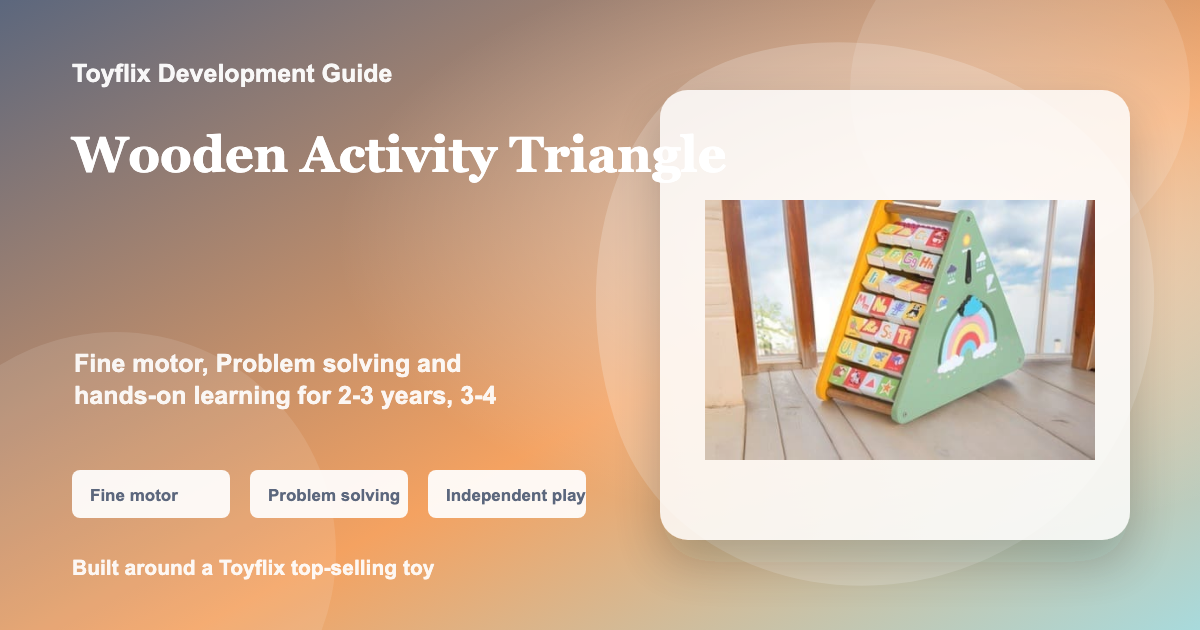
Wooden Activity Triangle: What This Top-Selling Toy Builds in Early Development
Wooden Activity Triangle builds fine motor strength, hand-eye coordination, curiosity and patient problem solving through hands-on exploration.
Wooden Activity Triangle is a lovely toy for children who want to touch everything and figure out how parts move. It gives them multiple surfaces to explore without overwhelming the room.
The developmental value is in the repeated hand work: sliding, turning, tracing, moving pieces and discovering that small actions create visible results.
Quick takeaways
- Builds hand-eye coordination, finger strength, attention and early problem solving.
- Works well for calm floor play and parent narration.
- The different sides let parents change the challenge without changing the toy.
Hands learn by doing, not watching
Young children need repeated chances to use fingers, wrists and eyes together. The activity triangle gives them those chances in short, satisfying loops.
A bead moves, a shape slides, a piece turns. Each result teaches the child that careful action matters.
Why wooden multi-activity toys hold attention
The triangle format gives variety without chaos. A child can move from one side to another, but the play still feels contained and understandable.
That balance helps children stay engaged longer than they might with a single-function toy, especially when parents rotate which side they introduce first.
Parent prompts that add language
Use words like up, down, around, through, stuck, smooth, fast and slow while your child explores. These words connect physical action to language.
For older toddlers, ask them to teach you how one side works. Explaining the toy strengthens memory and confidence.
Why it belongs in a rotation plan
Fine-motor toys are most effective when they feel fresh. If the triangle is always available, children may stop noticing its challenges.
Bringing it in for a focused window, then rotating to blocks, puzzles or pretend play, keeps the learning sharper.
FAQs
What skills does Wooden Activity Triangle build?
It supports hand-eye coordination, finger strength, attention, language and problem solving.
How can I keep the play interesting?
Introduce one side at a time, add descriptive words, and change the challenge once the child masters a movement.
Is it good for independent play?
Yes, once the child understands the toy. Stay nearby for safety, but allow them time to explore without constant correction.
See the real thing
Stop reading about toys. Go and pick some.
Hundreds of premium branded toys, matched to your child's age and swapped when they outgrow them. Free delivery across Bangalore, no deposit, no damage charges.
Browse all toysOr jump straight to