
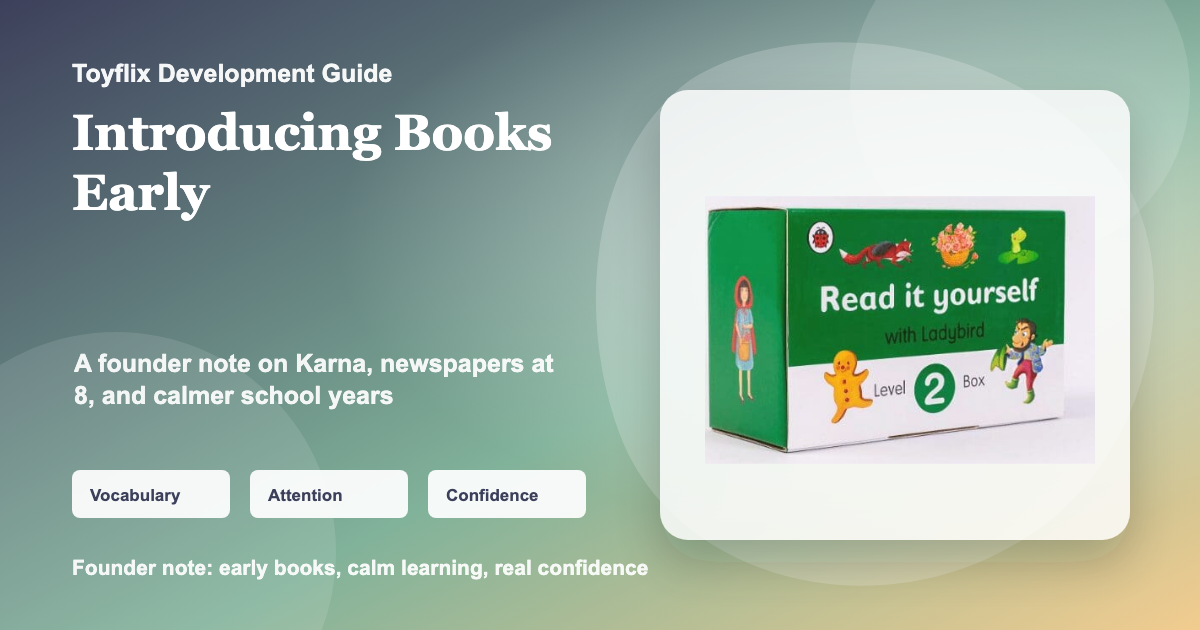
Introducing Books Early: What My Son Karna Taught Me About Reading and Calm Learning
A founder note on why early books matter: how Karna's reading habit grew into curiosity, newspaper reading at 8, and a calmer relationship with schoolwork.
One of the quietest decisions we made for Karna was also one of the most powerful: we introduced books early, before reading was treated like schoolwork. Books were part of the house, part of bedtime, part of waiting time, and part of everyday conversation.
By 8, Karna had started reading the newspaper with real curiosity. Not every page, not like an adult trying to finish the morning edition, but enough to ask questions about the world, new words, cricket scores, headlines and why grown-ups cared about certain stories.
Quick takeaways
- Early books work best when they feel like comfort and curiosity, not homework.
- Reading builds vocabulary, attention span and the confidence to learn independently.
- When children read naturally, parents often worry less about exams and homework because comprehension is already growing every day.
Books should arrive before pressure
Many children meet books first as a school demand: read this chapter, answer this question, finish this worksheet. We wanted Karna to meet books earlier than that, when pages still felt like stories, pictures, questions and closeness.
That changed the mood around reading. He did not have to perform every time he opened a book. He could browse, repeat, ask, skip, come back and slowly build the feeling that books belonged to him.
Why newspaper reading at 8 matters
When an 8-year-old reads a newspaper, the point is not that the child understands everything. The point is that the child is willing to enter adult language without fear. Headlines become vocabulary practice. Short articles become comprehension practice. Questions become conversation.
For Karna, this habit made reading feel connected to real life. It was not just a school skill. It was a way to understand what people were talking about at breakfast, in the car, and around the dinner table.
How it changed exams and homework at home
We still care about school. We still check what needs to be done. But when reading is strong, exams and homework do not feel like a daily emergency in the same way. The child can understand instructions, absorb stories, follow word problems and sit with a page for longer.
That is the real relief. Parents do not have to push every sentence from the outside. A reading habit creates an inner engine: curiosity, stamina and the confidence to try before asking for help.
How parents can start early without making it heavy
Keep books visible. Read the same favourite book many times. Let children choose silly books, animal books, vehicle books, picture books and early readers. Do not rush to correct every word if the child is still enjoying the page.
A small daily reading rhythm is enough. Ten relaxed minutes with a book can do more than a long forced session. The aim is to make books feel like a normal part of childhood, just like toys, conversation and outdoor play.
FAQs
When should parents introduce books?
As early as possible, even before formal reading begins. Babies and toddlers benefit from picture books, naming games, rhythm, repetition and the closeness of being read to.
Does early reading help with school exams?
It can help a lot because reading improves vocabulary, comprehension, attention and confidence. It does not replace study, but it makes schoolwork feel less intimidating.
What if my child does not sit still for books?
Start smaller. Use short books, picture-heavy books, funny voices, bedtime routines, or books about the child’s current obsession. The first goal is warmth and repetition, not finishing pages.
See the real thing
Stop reading about toys. Go and pick some.
Hundreds of premium branded toys, matched to your child's age and swapped when they outgrow them. Free delivery across Bangalore, no deposit, no damage charges.
Browse all toysOr jump straight to