
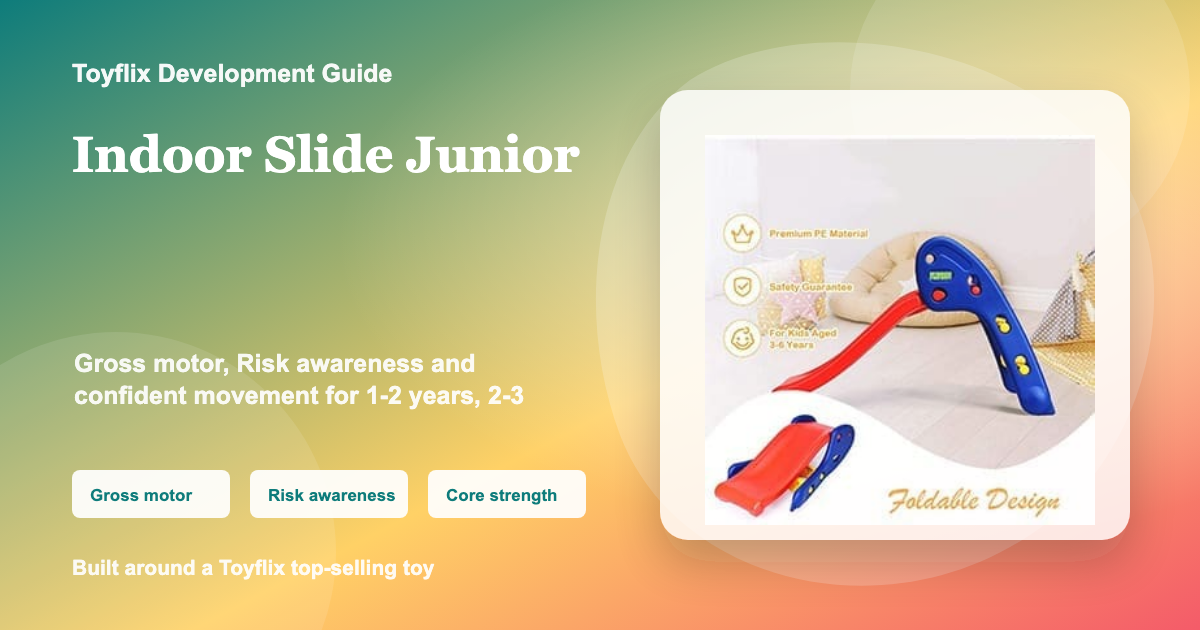
Indoor Slide Junior: What This Top-Selling Toy Builds in Early Development
Indoor Slide Junior helps toddlers practise climbing, waiting, sliding and landing safely: the small body skills behind confidence and risk awareness.
Indoor Slide Junior is not just a way to burn energy indoors. For a toddler, the whole sequence matters: walk to the steps, hold the side, climb, pause, sit, slide, land and decide whether to try again.
That loop gives parents a simple way to build movement confidence at home without turning play into a class. The toy is especially useful when a child wants big-body play but still needs close, calm supervision.
Quick takeaways
- Best for gross motor confidence, core strength, balance and early risk awareness.
- The biggest learning happens in the climb-wait-slide-land routine, not only in the sliding part.
- Keep sessions short and supervised; stop while the child is still confident rather than overtired.
The real skill is the whole movement sequence
A toddler has to plan several steps before the slide even starts. They shift weight, place feet, grip with their hands and judge when their body is ready to sit. That is motor planning in a very practical form.
Because the result is immediate, children quickly understand cause and effect: climb too fast and it feels wobbly, sit properly and the ride feels smoother, land with feet ready and the body feels safer.
How it builds risk awareness without fear
Safe risk is valuable. The slide gives children a manageable challenge where an adult can stay nearby but does not have to control every movement. The child learns to notice height, speed, body position and landing.
Use language like “slow feet”, “hold the side”, and “wait for your turn”. These small cues help children connect movement with judgement instead of treating active play as random excitement.
A simple home play routine
Start with three calm rounds. Ask your child to climb, sit, count one-two-three, then slide. Once that is easy, add a stuffed toy passenger, a colour target at the bottom, or a turn-taking cue with a sibling.
Avoid adding too many rules at once. Toddlers learn best when the body knows the pattern and the mind has only one new challenge to solve.
When to rotate it out
Slides are bulky and stage-specific. Many children love them intensely, then suddenly need a bigger movement challenge or more imaginative play.
Renting makes sense because you can use the slide during the exact window when climbing and landing practice matter, then move on without storing a large toy in the house.
FAQs
Is Indoor Slide Junior good for toddlers?
Yes, when supervised. It supports climbing, balance, core strength, turn-taking and safe landing practice.
How should parents use it safely?
Place it on a stable surface, stay close, keep one child on it at a time, and use short cues instead of rushing the child.
Why rent an indoor slide?
It is a large toy with a clear developmental window. Renting lets families use it when it is useful and rotate it before it becomes clutter.
See the real thing
Stop reading about toys. Go and pick some.
Hundreds of premium branded toys, matched to your child's age and swapped when they outgrow them. Free delivery across Bangalore, no deposit, no damage charges.
Browse all toysOr jump straight to